On short stories: Putting the only words in the only order
Short story writers are often told to ‘make every word count’. But what does this mean? And how can we identify and winkle out those sluggish words, clichéd ideas, and flaky images that once seemed so vital, original and essential in our own first drafts?
Mark Twain allegedly lamented to a friend he’d wanted to ‘write a shorter letter but didn’t have the time’. If the single defining element of the short story is its brevity, then precision is everything. And like any finely-tuned motor skill, precision takes practice and patience. Of course longer forms also depend on exactitude, but there are simply less places for dead ends or missteps to hide in a more concentrated hit of words. According to Mel Campbell ‘anyone can noodle on for 10,000 words, but it takes creativity and discipline to express oneself within word limits.’
Word count can be both friend and foe. A 500 word cap challenges the writer to keep on track, but that track still must offer an arresting glimpse of life, relationships, the world etc. On the downside, enforced limits can cramp your style. When a piece balloons over its allotted space, there are probably only two options. Keep it for another occasion when word limit isn’t an issue. Or cut.
Ali Smith talks about needing to find your own ‘balance between instinct and edit’. For some stories less will be more. For others, less really is less. Multiple ideas, extravagant details of setting and mood, the number of characters, or quirks of voice might be the very elements you’d hoped would hook and haunt the reader. Lose those hard-wrought surprises and idiosyncrasies, and the story risks diluting into ordinariness. If a story keeps buckling against the word limit, there’s no going wider. So go deeper.
Kurt Vonnegut said every sentence must either ‘advance the plot’ or reveal something compelling about the character. If I think a story is worth redrafting, one of the most useful questions is: ‘do I need this?’ First lines, last lines, dialogue, heavy-handed or colourless titles, characters’ names, favourite phrases – nothing is safe from the scalpel. Openings must act as irresistible invitations to read on, however Jennifer Mills warns against ‘strong beginnings’ petering out. As for endings, ‘a short story doesn’t have to have a neat ending, but it should turn – it should show readers the moment something changes.’
Priscilla Long suggests making a list of ten things you want to include before you start such as objects, feelings, colours, places, people, events, particular phrases. Even if you haven’t done this, go back and see what’s survived the redrafting knife. Is this still the story you wanted to write?
After fine-combing through several times, the words that kick-started the piece might suddenly seem clunky. Some will be worth refashioning. Others won’t. Check every word is working as hard as the 499 other pistons hopefully chugging away in the engine room keeping the story ticking over. Even the seemingly insignificant ones such as ‘the’ and ‘and’ must pull their weight.
Reading aloud can help detect stumbles, flat spots, unintended repetitions, clumsy rhythms, clanging notes. Try to imagine you’re sitting on the other side of the editor’s desk, listening in. What would make this story leap straight over the ‘no’ pile and into the ‘yes’?
Some pieces will never amount to more than exercises. But the act of writing is never wasted. Set them aside for awhile, then revisit and try to see what you’d change in them now. Some pithy lines might even be salvageable for recycling elsewhere.
At this year’s Byron Writers Festival, Jeanette Winterson talked about the benefits of having a wood-burning stove in her study. Apparently she feeds it regularly with paper and ink. She also said that good writing of any length means putting ‘the right words in the right order’. Later, this was refined slightly. Good writing is about finding ‘the only words’ and putting them ‘in the only order’. No multiple choice. No ‘and/or’. There’s only one right word, or 500 right words. And it’s every writer’s job to pounce on them and place them where they can chug away, unfettered, at full capacity.
This article first appeared in the Northern Rivers Writers Centre’s newsletter northerly, November 2014.
Emma’s short stories have been widely published including in The Age, Commonwealth Writers Magazine adda, Griffith Review, Overland, Review of Australian Fiction, Sleepers Almanac, and on three Brisbane billboards for #8wordstory. She was shortlisted for the 2019 Commonwealth Short Story Prize, 2019 Newcastle Short Story Prize, 2018 Overland/NUW Fair Australia Prize and 2001 Age Short Story Award. Her debut novel The Floating Garden was shortlisted for the 2016 Small Press Network MUBA prize. Her short story collection Dreams They Forgot will be published in September 2020 by Wakefield Press.
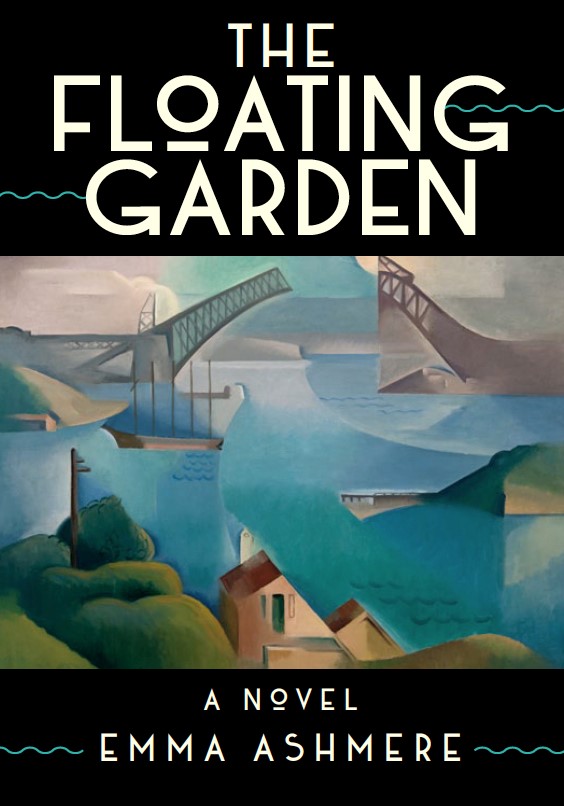 Set in Sydney in the 1920s, The Floating Garden beautifully and evocatively portrays both the difficulties and the sense of promise in the post-war era. Through the eyes of Ellis and Rennie, we witness the changes in the tight-knit community of Milsons Point as Sydney’s iconic harbour bridge is built. The novel begins as landlady (and secret gardening writer) Ellis sees the last of her lodgers depart as the demolishers rapidly approach. Ellis appears to be trapped in the crumbling house by inertia and memories. Rennie, on the other hand, appears to have it all—a wealthy husband and a career of sorts as an exhibiting artist. Their worlds collide when Rennie knocks on Ellis’ door seeking refuge from her abusive husband…. This is Emma Ashmere’s first novel after a series of award-winning short stories. There is something quintessentially Australian about this book, and at times it reminded me of Tim Winton’s Cloudstreet.
 Emma Ashmere